Showing posts with label Lupine Publishers Environment Journals. Show all posts

Saturday, 14 September 2019

Lupine Publishers | Environmental and Soil Science

Some Aspects of Red Special Wines by Temur Gvinianidze

Abstract

Due to increasing environmental radionuclide background, the scientists and specialists constantly face the problem of developing technologies for producing plant-based, therapeutic-purpose foods and food supplements enriched with biologically active substances, which are characterized by high immunomodulating, radioprotective and antioxidant activity. From such therapeutic-purpose foods and food supplements, of particular importance are the beverages because their improved composition, sensory and liquid consistency provide high availability and increased therapeutic capacity.
Keywords: Radionuclide; Antioxidant Activity; Grapes; Food; Special Wine

Introduction

Natural and special wines form the great part of the export potential of Georgia. The fact that according to figures on exports of wine and alcoholic beverages only for the first nine months of 2017, Georgia exported 52.7 million bottles (0,75 l) of wine. According to the National Wine Agency, wine exports have grown up on 63% in comparison with corresponding period last year [1,2]. It is also noteworthy that since the 80s of the last centuries, poor-quality and expensive sprays and brought to our country have caused significant damage to the indigenous and alien grape varieties. Georgian farmers were forced to switch partly to growing of nontreated and hybrid grape varieties, because they do not require expensive and imported from outside sprays, and besides, hybrids and clones are easy to grow, and different types of fungi and other diseases are no big deal for them. Today, wineries cannot apply even industrial varieties of colored grapes such as Aladasturi, Dzelshavi, Mgaloblishvili and Black Pinoa [3,4].
In view of the foregoing, it reasonable and relevant to develop the innovative technologies for producing natural and special wines from common to western Georgia Therefore reasonable and relevant to western Georgia-known less marketable local raw materials of colored grape industrial varieties and nontreated grape clones enriched with from biologically active substance enriched with innovative technology of special wines, which are characterized by high sensor, radioprotective and antioxidant activity therapeutic properties for preventing food-borne diseases [5-7]. The goal of the work is to develop special wine technology enriched with biologically active substances from the grape raw materials of grape varieties cultivated in the Imereti Viticulture and Winemaking Area, which is characterized by improved sensory indicators and increased therapeutic and preventive capacity. In addition, in this special wine technology, for the first time in Georgia, there will be used raw materials of the nontreated colored Zeibeli grape variety cultivated in the Baghdati Viticulture and Winemaking micro-zone, rosehip and grape-seed alcohol-wine extracts and small quantity of white honey for the purpose of increasing the flowers tonality.

Objectives and Methods

Object of Study
Raw materials of “Otskhanuri Sapere” grape variety from the Imereti Viticulture-Winemaking subzone, particularly from the Zestafoni district’s village of Sviri and the Bagdati district’s village of Obcha; raw materials of “Aladasturi” grape variety from the Middle and Lower Imereti Viticulture-Winemaking subzone, particularly from the Bagdati district’s village of Rokhi and the Vani district’s villages of Pereti and Kumuri, from the Patele Area’s vineyards; raw materials of “Zeibeli 5455” (“Zeimberi”) grape variety from the Lipnari vineyards; vacuum-must; grape-seed extract; wildgrowing dog-rose from the Zekari and Sairme valleys and extracts and concentrates obtained from their skins and fleshes; lime-tree flower honey from the Zekari and Sairme valleys; rectified ethyl alcohol [8].
Research Methods
When determining the physical-chemical indicators of grape raw materials, wine materials and finished special wine, we used the standard, universally accepted and modified organoleptic and physical-chemical methods, including chromato-massspectrometry, high-performance liquid and gas chromatography, spectrophotometry and fluorometry

Results and Analysis

To implement this goal, the following objectives should be attained [9-14]:
a. To study the mechanical composition of selected raw materials;
b. To provide uvological evaluation of raw materials;
c. To study the chemical composition and sensory characteristics of raw materials;
i). To justify theoretically and experimentally the optimal composition of grapes raw material required for special wine
ii). To develop rational technology of colored grape raw materials processing, alcoholic fermentation and ageing;
iii). To study the influence of thermal conditioning regimes of the seeds and skins on the extraction of phenolic and dye compounds;
iv). To develop the optimal technological regimes and approaches for the production of ingredients required for special wine: semi-fermented wine, condensed grape vacuum-must, and grape-seed and dog-rose extracts;
v). To provide quantitative and qualitative evaluation of biologically active substances of special wine;
vi). To develop technological schemes for producing ingredients of special wine;
vii). To develop technological schemes for special wine production;
viii). To assess sensory characteristics and antioxidant activity of special wine.
ix). At the initial stage we studied and evaluated the mechanical, physical, chemical and sensory characteristics of the selected grape raw materials.
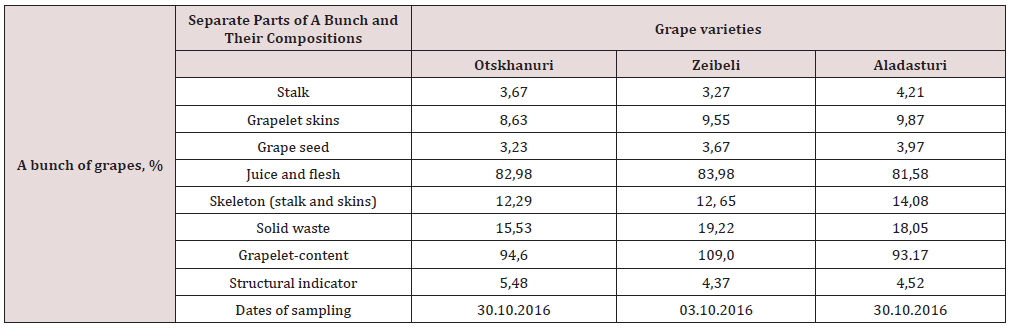
The grapes are the main raw material for wine production, and we have identified the mechanical composition of the bunch in compliance with the requirements suggested by Prostoserdov. (Table 1) We have carried out studies and evaluation of the chemical composition and variety flavor of selected grape raw materials (Table 2). Studies show that the value of sugar-acid ratio affects numerous characteristics of wine, in particular the higher is this ratio, the better is the quality of special wine. Along with the selection of high-quality raw materials in the production of red special wines, the fermenting and fermentation processes have the main function in the formation of a sensory bunch [15,16].
Table 1:  The uvological characteristics of grape varieties from Imereti.
Table 2:  Physical-chemical characteristics of the selected grape raw materials.
The List of the Proposed Innovations is as Follows:
I. Adding of pectolytic (with activity 2000-2200 unit/g) enzyme (Rapides CR) to the seeds and skins during the process of pressing in a grape stalk separator, increases the yield of the must by 5-7% and the content of biologically active substances for 1-2 ml/100 kg.
II. Adding of potassium metabisulfite within 54-63 mg/dm3 significantly increases extraction of anthocyanins, increases to 1.2 - 4.3 g/dm3 the reduced extract and the content of dyes, contributes to purification, the growth in terpenic compounds by 2,1-2,7%, and the growth in a stable fraction of a phenolic complex (within 20-25%) in wine.
III. We added 1-2% of Aspergillus fungus of the dry active yeast in a grape stalk separator (C-R-9001 or C-RB-9001- fungus works at the temperature of 12 - 280C, pH=3.0-5.4 and increases alcohol content up to 24%, and significantly increases the content of terpens and esters in wine).
IV. Adding of the condensed concentrate with the content of dry substances up to 54-63 % through the dog-rose lyophilic drying to the seeds and skins within 50-75 mg/dm3, in the presence of or cadifite (40-70 mg/dm3) either SO2 (90±10 mg/ dm3) increases by 1.5-1.8 the development of variety flavor in a special wine.
V. During the fermentation of the seeds and skins, we raised the sugar content up to 27% by adding the vacuum-must and honey, due to which terpenic compounds were increased by 0.7-1.2 %, and esters by 24-27%.
VI. We have established that after tye 6-day extractionfermentation at a temperature of 270C, the seeds and skins are subject to heat treatment at a temperature of 540C, and hot pressing, which significantly increases separation of phenolic and dye compounds.
VII. Adding of the grape-seed and dog-rose concentrates and heat-treated grape-seed (5 g/dal) and oak shavings (5 g/dal) significantly improves the rancio tones and sensory bunch.
VIII. In 16-18 months, adding of dry dog-rose pulp and peel (20 g/ dal) increases the flavor-forming complexes.
IX. Adding of the grape-seed and dog-rose concentrates and heat-treated grape-seed during the ageing process, under conditions of periodic pasteurization and stirring within 2-3 months, increases the total amount of phenols by 0.3 - 0.4 g/ dm3, and improves the rancio tones and sensory bunch.
X. Prohibition of using gelatin and bentonite clays, because for processing wine materials, bentonite clays reduced the anthocyanins by 27-36% on 2-3 kg/t, while the use of gelatin reduced the compounds of phenolic compounds by 6-9% on 2-3 g /t.
XI. Creating a new technology by using new varieties and honey flower tones.
XII. We have studied the impact of the temperature of the fermentation of the seeds and skins on the extraction process anthocyanins from the skins in the fermenting mass. Studies were carried out at four temperature intervals 34-360C, 27- 300C, 21-250C and 16-180C.
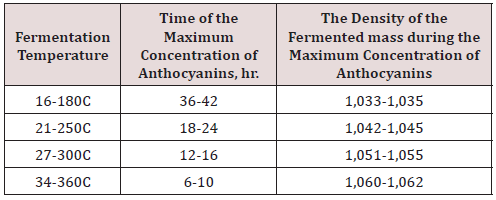
Table 3:  Physical and chemical characteistics of pomace fermentation.
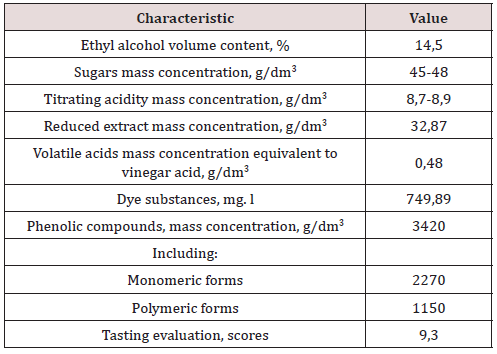
Table 4:  Special wine characteristics after the 18-month ageing.
Table 3 shows the main fermentation temperature, the duration of maximum extraction of anthocyanins and the density of the fermented mass. Table 4 contains the physical, chemical and sensory characteristics of the special wine after the 18-month aging. In all five samples, the content of raw materials of Zeibeli grape variety varied between 10-20%, while the amount of raw materials Aladasturi and Otskhanuri Sapere grape varieties - between 20- 50%. Aladasturi and Otskhanuri Sapere grape varieties were blended in the proportion 36:48:16 (percentage ratio). As shown from the table, the wine produced has a high sensitivity rate (9,7 cents), which is the result of the composite effects of the selected raw materials of the selected raw materials, the use of ingredients and the technological processes of individual technologies.

Conclusion

A. It has been experimentally determined that the grape picking should be done when the concentration of the sugar content in the grapes is not less than 23-24g/100 cm3 and titrated acidity is 6-8 g/dm3. And pressing of grapes in a rolling grape stalk separator enriches the seeds and skins with the phenolic complexes of stalk.
B. It has been established that colored grape raw materials blended with an optimal ratio of “Aladasturi”, “Otskhanuri Sapere” and “Zeibeli 5455” grape varieties is promising for the production of high-quality special red wines with a distinctive variety flavor, and rich technological reserves of phenolic (3765-4314 mg/kg) and dye (976-1432 mg/kg) compounds.
C. The optimal version of blending for producing a special dessert wine with the best sensory bunch has been determined experimentally:(“Otttsanuri Sapere”): (“Aladasturi”): (“Ziebeli 5455”) = (27-36%): (42-54%): (16-18%).
D. It has been investigated that in the process of pressing in a grape stalk separator, in the composition with the enzyme preparation Rapidase CR the kernel gap in the 1-2 mL / 100 kg of enzyme preparation in potassium metabisulphite with 54- 63 mg/dm3 and special (dry active yeast) Aspergillus fungus 1- 2% Composition (CR-9001 or C-RB-9001-fungus works at temperature of 12-280C, pH = 3,0-5,4 and stands alcohol up to 24%), increases the the yield of must, sensory characteristics, the content of extractive (increases the reduced extract up to 1,2- 4,3 g/dm3) and dye substances in wine and contributes to its rapid purification.
E. It has been established that sulphiting of the seeds and skins with potassium metabisulphite with 54-63 mg/dm3, contributes to the emergence of the variety flavor (increase of terpenic compounds by 2,1-2,7%) and the increase in phenolic complex (within 20-25 in wine).
F. There has been determined the relationship between the creation of the flavor-forming complexes and the sugar mass concentration in grapes raw materials, in particular the content of terpenic compounds is increasing by 0,7-1,2%, and the content of esters-by 16-27% when the sugar content in grapes raw materials is 22-27 g/100 cm3, then when sugar content in the grapes is less than 18.6%.
G. It has been studied that through the dog-rose lyophilic drying until 54-63%, adding of the condensed concentrate to the seeds and skins within 50-75 mg/dm3, in the presence of or cadifite (40-70 mg/dm3) either SO2 (90±10 mg/dm3) increases by 1.5-1.8 the development of variety flavor in a special wine
H. It has been experimentally determined that during the aging process of wine material, adding of:
i). dehydrated dog-rose pulp and peel at 20 g/dal,
ii). thermally-treated oak crumb at 5 g/dal,
iii). thermally-treated grape-seed at 5 g/dal
I. Under conditions of periodic pasteurization and stirring within 2-3 months, increases the total number of phenols by 0.3-0.4 g/dm3, improves the rancio tones and sensory bunch.
J. It has been established that after completion of ripening (16- 18 months), adding of dog-rose condensed extract to wine material within 50-70 mg/dm3, slows down the phenolicquinone transformations and increases the flavor-forming complexes.
For more Lupine Publishers Open Access Journals Please visit our website:

For more Open Access Environment Journal articles Please Click Here:
To Know More About Open Access Publishers Please Click on Lupine Publishers

Monday, 15 July 2019

The Biodiversity of Aquatic Gastropods in the Steppe Zone the West Siberian Plain (Western Siberia, Russia)


Lupine Publishers- Environmental and Soil Science


Abstract


This study describes the species diversity, abundance and biomass of gastropods in the ecosystems of the southern part of Western Siberia (Karasukskii district, Novosibirsk Oblast). Distribution and Quantitative Characteristics of Common Species of Gastropoda are calculated. Twenty-one species of snails belonging to seven families were recorded, Lymnaeidae, Planorbidae, Bulinidae, Physidae, Bithynhdae, Succineidae, and Zonitidae. The biodiversity of mollusks was studied using the Shannon- Weaver index.

Introduction

The ecology of pond snails has been studied in the waterbodies of the central part of European Russia [1], but the authors emphasize the necessity of conducting similar studies in Siberia, and in other regions of our country. Gastropoda are widely distributed in the water bodies of the southern part of Western Siberia. They are an important component of benthic communities and take part in a number of trophic relationships. Some information about the ecology of freshwater snails’ species is presented in the publications [2-4] but many aspects are still poorly studied. In particular, quantitative data on the communities of mollusks are scanty [5,6]. We, in a previous work [7] Jacquard index biodiversity gastropods are calculated. The aim of the present investigation was to identify the occurrence and distribution of freshwater snails in the lake, rivers systems from the steppe zone the West Siberian Plain.

Materials and Methods

The species composition and biomass of snails in August of 2009 were studied (Novosibirsk Oblast, south of Western Siberia). Samples were collected in different parts in the Karasuk River in the upstream(near the villages of Bystrukha N 54026’ 53,2’’; E 800 55’ 50,5’ and Chernovka N 540 09’ 53,2’’; E. 800 02’ 54,2’) and downstream near the villages of Gramotino and Sorochikha (N 500 45’ 19,4’’; E. 780 20’ 15,1’ and N 530 43’ 19,7’’; E 770 56’ 29,5’), and in six lakes of the Karasuk system: Astrodym N 53036’ 59,4’’; E 770 48’ 04,7’, Krivoye (reaches: Blagodatnoye N 530 49’ 59,3’’; E. 780 03’ 17,3’’, Sopatoye N 530 48’ 28,7’’; E 78002’ 18,5’’ and Gusinoye N 530 48’ 13,0’’; E 78004’ 00,8’’), Krotovo N 530 43’ 30’’; E 770 51’ 31’’, Kusgan N 53044’ 23’’; E 770 53’25’’, Melkoye N 530 47’ 37,9’’; E 780 16’34,91’’, Titovo N 530 45’ 25,8’’; E 770 56’13,2’’.
The hydrological and hydrochemical characteristics of the rivers and lakes in steppe zone in the West - Siberian Plain are presented in the study by Savchenko (2010). The study was based at the Karasuk Field Station (Institute of Systematics and Ecology of Animals Russian Academy of Sciences; Karasukskii district, Novosibirsk region). Mollusks were collected according to the standard technique [8]. For a quantitative analysis of snails in the lake-river systems they were collected by hand from sites of 0.25 m2 (50х50 cm). The control sites were in open parts and in macrophyte stands at a depth of 0.1-1.1 m. To determine biomass, the collected mollusks were dried on a filter paper for ≥1 min and weighed. The species identification was made according to the shell and genital system using the keys [9,10]. The ICA index (index of copulatory apparatus) was one of the major criteria for the species definition of mollusks. The species definition within the Lymnaeidae index for mature specimens into account [6].

Results

Species Composition of Gastropods

In the Karasuk river - lakes system, of 21 species from 7 families of gastropods were recorded: Pond Snail - [Lymnaeidae]; Lymnaea (Radix) auricularia (L.,1758), L. (Peregriana) balthica (L., 1758); L. (P.) fontinalis (Studer, 1820), L. (P.) ovata (Drap., 1805), L. (P.) ampla (Hartmann, 1821), L. (P.) tumida (Held, 1836), and Lymnaea (Stagnicola) saridalensis (Mozley, 1934) and Great Pond Snails (Lymnaea) stagnalis (L., 1758), L. (L.) fragilis (L., 1758), L. (L.) doriana (Bourguignat, 1862); Ramshorn snails, Planorbis planorbis (L., 1758), Anisus vortex (L., 1758), A. contortus (L.,1758), Segmentina nitida (Mull., 1774) [Planorbidae], and Planorbarius corneus (L., 1758) [Bulinidae]; Physa fontinalis (L., 1758), Aplexa nypnorum (L., 1758) [Physidae]; Bithynia tentaculata (L., 1758) and B. troscheli (Paasch, 1842) [Bithyniidae]. Terrestrial gastropods were defined by genus, Succinea sp. [Succineidae] and Zonitoides sp. [Zonitidae].
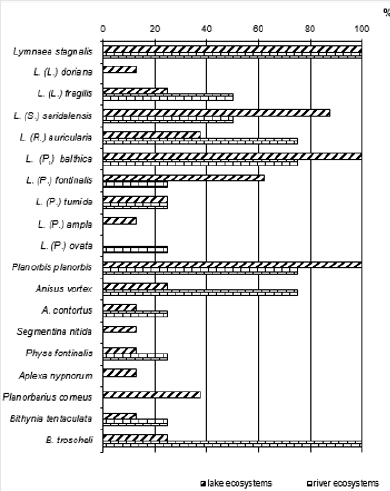
Figure 1: Distribution (%) of gastropods in the Karasuk River and lakes of the Karasuk system
lupinepublishers-openaccess-journal-environmental-soil-sciences
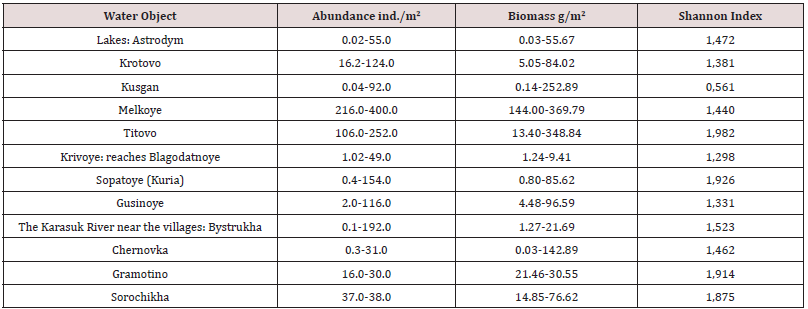
Table 1: Abundance and biomass of gastropods and the Shannon index in water objects from the Karasuk system.
lupinepublishers-openaccess-journal-environmental-soil-sciences
Sixteen gastropod species were recorded in the river and 20 in the lakes (Figure 1). Fifteen species were common for both the river and the lakes. The snails L. (P.) ovata were found in the river only and five species were found only in the lakes: (L. (L.) doriana and L. (P.) ampla, only in the Astrodym lake; S. nitida only in the Krotovo lake; A. nypnorum only in the Melkoye lake). Ramshorn snails P. corneus were found in the Krivoye Krotovo and Titovo lakes. Gastropoda in modern freshwater water bodies (the steppe zone West Siberian Plain) are represented by Pulmonata and Prosobranchia species. Both secondary aquatic pulmonate snails (four families) and terrestrial species (two families) were recorded in the study area. The terrestrial snails inhabit plants that grow close to the water’s edge and appear in the samples of aquatic species. Prosobranchia snails are primarily aquatic; they are the most ancient colonizers of the continental water bodies and are represented by only one family, Bithyniidae. Both bithyniid snails were recorded only in the upper stream of the Karasuk River (close to Bystrukha Village) and in Krotovo Lake [11].

Assessment of the Abundance and Biomass of Gastropods

The abundance of snails in the river varied from 10 up to 192 ind./m2 (Table 1). Lymnaeidae snails dominated, followed by Bithyniidae snails were sub-dominants. The Shannon-Weaver index, as calculated under the gastropod population density, indicated an increase of the species diversity from 1.4-1.5 bit/ind. (upper stream) up to 1.8-1.9 bit/ind. (lower stream). The maximum abundance of snails in the lakes varied from 49 up to 400 ind./m2. (Blagodatnoye reach and Melkoye). In lakes the Shannon-Weaver index varied from 0.56 bit/ind. (Kusgan) up to 1.9 bit/ind. (Titovo; Sopatoye reach). The maximum biomass of gastropods in the river varied from 21.7 to 142.9 g/m2; or in lakes from 9.4 to 369.8 g/ m2 (Blagodatnoye reach and Melkoye). Lymnaeidae snail’s biomass were dominated by, both in the river and in the lakes [12,13]. It should be mentioned that high abundance did not always correlate with high biomass. Thus, the high abundance (192 ind./m2) of L. stagnalis corresponded to the biomass 1.26 g/ m2, which can be explained by the prevalence of young snails in the samples. Although an adult L. stagnalis can weigh 4.9 grams.
 Twenty-one species of snails belonging to seven families were recorded, Lymnaeidae, Planorbidae. Bulinidae, Physidae, Bithynhdae, Succineidae, and Zonitidae. All the recorded mollusk species are common in water bodies that are characterized by slow cur rents, in stagnant (mostly perennial) and semilotic water pools; they are common species in the southern part of Western Siberia. Lymnaeidae snail’s biomass were dominated by, both in the river and in the lakes.


For more Lupine Publishers Open Access Journals Please visit our website: https://lupinepublishersgroup.com/

For more Open Access Environment Journal articles Please Click Here:


To Know More About Open Access Publishers Please Click on Lupine Publishers

Friday, 21 June 2019

Lupine Publishers- Open Access Environment Journals


The beginning of Human being’s effort to meet the need for food production in parallel with the increasing number of population and environmental deterioration is lost in time. One of such known effort was green revolution which started in 1968 in order to revolutionize agricultural sectors through the utilization of modern technologies. Since agriculture is the fundamental source of livelihood for the majority of human population especially in developing countries, it will always be helpful to study any agricultural aspects to take lessons from it. Accordingly, this review article tries to study the historical, implementation and shortcoming of green revolution. The study only used secondary data materials.


For more Lupine Publishers Open Access Journals Please visit our website
For more Open Access Environment Journals Article Please Click Here:


Wednesday, 29 May 2019

Lupine Publishers- Open Access Environment Journals


Change of Evaporations Leads to Climate Change by Oleg Khalidullin in OpenAccess Journal of Environmental and Soil Science in Lupine Publishers

The basis of all floods and droughts is water, its excess in some places and lack of it in others. Both here and there the biota dies. Water is the main mediator, means and condition for the existence of life on the planet. Water accumulates in the clouds, moves, precipitates, dissolves minerals and organic matter in itself, delivers it to animals and plants. Water itself is not a product, it is a supplier, component and builder of cells, matter of all biota. Each plant species and a living organism, and within each species, each individual has his own personal ability to extract the substances dissolved in it. And water does not disappear, it is contained in every cell of the body and leaves the body after performing its functions in the form of exhalation, excretions, sweat, transpiration of plants have their own specific individual properties. The structure of each type of discharge is strictly individual and has its own purpose. This is how we feel the fragrance of flowers when inhaled; animals smell their victims and partners by smell. Exhalation and urine doctors diagnose diseases. All of these secretions are concentrated in the atmosphere and are called aeroplankton [1]. American microbiologist Parker found that air contains a large amount of organic matter and a variety of microorganisms, including algae, some of which are active. The temporary location of these organisms can be, for example, cumulus clouds. Acceptable for the flow of vital processes temperature, water, trace elements, radiant energy - all this creates favorable conditions for photosynthesis, metabolism and cell growth. According to Parker, “clouds are living ecological systems,” giving multicellular microorganisms the opportunity to live and multiply. “ From this it can be assumed that this plankton is formed into a single substance and creates a special mechanism that programs the volumes, terms and places of precipitation, forms special clouds.

https://lupinepublishers.com/environmental-soil-science-journal/fulltext/change-of-evaporations-leads-to-climate-change.ID.000125.php
https://lupinepublishers.com/environmental-soil-science-journal/abstracts/change-of-evaporations-leads-to-climate-change.ID.000125.php
https://lupinepublishers.com/environmental-soil-science-journal/pdf/OAJESS.MS.ID.000125.pdf

For more Lupine Publishers Open Access Journals Please visit our website
For more Open Access Environment Journals Article Please Click Here:


Thursday, 9 May 2019

Lupine Publishers-Environmental Science Journal Impact Factor


Investigating the breeding population and soil texture of breeding sites of four Terns, Crab Plover, and Western Reef Heron on the islands of Khan, Nakhilou, Om-al-Gorm, and Tahmadon in Mond Marine National Park in Persian Gulf carried out in the spring and summer in 2015. Twenty-two species of water birds identified on the islands. Eight species of them were breeder and reminder (14 species) was passage. The dominant species was Bridled Tern Sterna Anaethetus with 170427 breeder pairs that had bred on sandy ground under the Atriplex bushes. The populations of Lesser Crested Tern Sterna bengalensis and Greater Crested Tern Sterna bergii were 19933 pairs in Nakhilou and Om-al-Gorm Islands that had bred also on the Sandy ground. The breeder population of Western Reef Heron Egretta gularis was 12, 72, and 45 pairs in Om-al-Gorm, Nakhilou, and Khan Islands respectively. The nests have been built on the short bushes. The breeder population of Crab Plover Dromas ardeola was 2266 on Nakhilou and 481 on Om-al-Gorm. The nests of this species have been built under ground in tunnels. Soil texture of tern’s nests sites in Nakhilou, Island consisted of 94.6% sand, 1.3% silt and 4.1% Clay, and under Atriplex bushes was 95.4% sand, 1.7% silt and 3.9% Clay. Soil texture of terns nesting sites in Om-al-Gorm, Khan, and Tahmadon consisted of 93.4% sand, 1.7% silt, and 4.9% clay; 92.8% sand, 2.7% silt and 4.7% clay, 89.4% sand, 3% silt and 7.6% clay respectively. The soil texture of the nesting sites on four islands did not differ significantly (p=0.05).


For more Lupine Publishers Open Access Journals Please visit our website


Friday, 3 May 2019

Lupine Publishers-Peer Reviewed Environmental Journals


Geophysical and Geotechnical investigations were carried out on the proposed New Oil Mill at Wilmar Calaro Oil Palm Estate in Awi- Akamkpa of Cross River State. Five borings were carried out at the depths of 42.3 m and 3 m at intervals of 1m and 4.7 m respectively. The samples were taken to the laboratory for Sieve analysis, compaction test, California Bearing ratio test, plasticity index, maximum dry density, unconfined triaxial test, and shrinkage test to determine the bearing capacity of the soil. The results revealed that the subsurface displayed good bearing capacities characteristic of (1.5m and 467.20KN/m2). Settlement predictions based on a loading of 100KN/m2 indicated a settlement of 1.68 mm. Hence, the subsurface is adjudged to be suitable for the proposed construction with the expected superstructure. Seismic refraction was also carried out in the locations the geotechnical borings were made using a 12channel seismograph (Teraloc) model DPU 411 to determine the bearing capacity of the subsurface. The five selected locations that were investigated shows that the hammer source penetrated the first three layers of the earth. A software seislmager was used to analyze the data. The range of Velocities for the first three layers were 276 m/s to 1148 m/s, 544 m/s to 2270 m/s and 1134 m/s to 5368 m/s, their depths to bottom were 1. 7 m to 8.1 m and 7.2 m to 13.5 m and the shear modulus (μ) of 0.97 x 10⁸N/m2, young modules (E) of 2.06 x 10⁸N/m2 to 331 x 108N/m2, Lame’s constant (λ) of 0.14 x 10⁸N/m2 to 927 x 108N/m2 and Poisson ratio (σ) of 0.01 to 0.3 were calculated, the soil identified in the survey area were mainly sand, clay, shale, gravel, and granite. Seismic refraction and geotechnical results show a good agreement that the soil is well consolidated, and it is suitable for the expected deep foundation building.


Wednesday, 27 March 2019

Lupine Publishers-Environmental and Soil Sciences


More than 150,000 Gallerias, Qanat Karez sweet water systems, including more than 200,000 kilo meters of tunnels still exist in the Middle East, Central Asia and Mediterranean basins. Since the Islamic agricultural revolution which took control of these water sources, they are operated inefficiently losing uncontrolled quantities of water. The original ancient design was to direct water to arid zone of sabkha basins in order to leach salt deposits by leaching, (you have used leaching twice) recrystallizing and precipitating the salts as pure thick strata S of salt crust. The tunnels are used today only for domestic and local agricultural water supply. The engineering and construction of these systems involved extremely heavy investment, in difficult desert conditions. The human cost of building the tunnels and boreholes could only have been justified by the value of the salt production resulting from the irrigation and flooding mechanisms. This forgotten technology is no longer in use and the misunderstanding has caused misuse and inefficiency Many communities still rely on the ancient Qanat.


Tuesday, 26 February 2019

Lupine Publishers- Environment Journals


In recent years, both in the Republic and in the CIS and far abroad are developing low-intensity stationary systems of irrigation, consisting of Micro Sprinklers, impulsive actions, aerosol auto oscillatory action sprinkling irrigation, auto oscillatory action auto oscillatory action combined, the drip, drip pulsing and a number of others. This is because low irrigation system has a number of significant advantages over other methods of irrigation. Especially promising the creation of automated sprinkling systems impulse machines, combined, auto oscillatory action stepper auto oscillatory action rocker type, pulse-airborne apparatus auto oscillatory action, etc.


For more Lupine Publishers Open Access Journals Please visit our website


Soil and Environment

  Mini Review Soil is a blend of natural issue, minerals, gases, fluids, and life forms that together help life. Earth’s collectio...