Lupine publishers|Effect of Interaction Between Ag Nanoparticles and
Salinity on Germination Stages of Lathyrus Sativus L.
 Lupine publishers|Earth and environment journals
The aim of the study was to effect of interaction between Ag nanoparticles and salinity on Germination Stages of Lathyrus Sativus
L. Treatments included in the study were viz. To 3 levels of salinity (0
as control, 8 and 16 dS/m NaCl), 8 and 16 dS/m and four levels
of silver nanoparticles (0, 5, 10 and 15 ppm) on grass pea seed were
tested. An experiment was conducted to evaluate the effects
of silver nanoparticles (AgNPs), on the seed germination factors, root
and shoot length (RL and SL) and proline content of grass
pea Survival under Salinity Levels. Results showed a significant
reduction in growth and development indices due to the salinity
stress. The salt stress impaired the germination factors of grass pea
seedlings. The application of Ag in combination improved the
germination percentage, shoot and root length, seedling fresh weight and
seedling dry weight and seedling dry contents of grass
pea seedlings under stressed conditions. The results suggest that Ag
nanoparticles enhancement may be important for osmotic
adjustment in grass pea under salinity stress and application of Ag
mitigated the adverse effect of salinity and toxic effects of salinity
stress on grass pea seedlings.
Keywords: Ag nanoparticles; Salinity; Germination Stages; Grass Pea; Lathyrus Sativus L.
High salinity is a common abiotic stress factor that causes a
significant reduction in growth. Germination and seedling growth
are reduced in saline soils with varying responses for species
and cultivars [1]. Soil saltiness may impact the germination
of seeds either by causing an osmotic potential outside to the
seed averting water uptake, or the poisonous effects of Na+ and
Cl− ions on germinating seed [2]. Salt and osmotic stresses are
responsible for both inhibition or delayed seed germination and
seedling establishment [3]. The majority of our present-day crops
are adversely affected by salinity stress [4]. NaCl causes extensive
oxidative damage in different legumes, resulting in significant
reduction of different growth parameters, seed nutritional quality,
and nodulation [5,6]. To mitigate and repair damages triggered by
oxidative stress, plants evolved a series of both enzymatic as well
as a non-enzymatic antioxidant defense mechanism. Ascorbate and
carotenoids are two important non-enzymatic defenses against
salinity, whereas proline is the most debated osmoregulatory
substances under stress [7].
Lathyrus Sativus L. (Grass pea) is an annual pulse crop belonging to the Fabaceae family and Vicieae tribe [8]. Grass pea has a long history in agriculture. The crop is an excellent fodder with its reliable yield and high protein content. This plant is also commonly grown for animal feed and as forage. The grass pea is endowed with many properties that combine to make it an attractive food crop in drought-stricken, rain-fed areas where soil quality is poor and extreme environmental conditions prevail [9]. Despite its tolerance to drought it is not affected by excessive rainfall and can be grown on land subject to flooding [10,11]. Compared to other legumes, it is also resistant to many insect pests [12-15]. Nanoparticles (NPs) are wide class of materials that include particulate substances, which have one dimension less than 100 nm at least [16]. The importance of these materials realized when researchers found that size can influence the physiochemical properties of a substance e.g. the optical properties [17]. NPs with different composition, size, and concentration, physical/ chemical properties have been reported to influence growth and development of various plant species with both positive and negative effects [18]. Silver nanoparticles have been implicated in agriculture for improving crops. There are many reports indicating that appropriate concentrations of AgNPs play an important role in plant growth [19,20]. The application of Nano silver during germination process may enhance germination traits, plant growth and resistance to salinity conditions in basil seedlings [21]. The use of Silver Nanoparticle on Fenugreek Seed Germination under Salinity Levels is a recent practice studied [22]. Nanomaterials have also been used for various fundamental and practical applications [23]. Although the potential of AgNPs in improving salinity resistance has been reported in several plant species [24,25], its role in the alleviation of salinity effect and related mechanisms is still unknown. Therefore, the main objective of this work was to study the effect of Silver Nanoparticles on salt tolerance in Lathyrus Sativus L.
In order to investigate salinity stress on Lathyrus Sativus L.
germination indices, an experiment was carried out in Iran from
April to Juan 2017 at Ferdowsi University of Mashhad, to creation
salinity, sodium chloride at the levels of 8 dS/m, 15 dS/m and 0 (as
control), four levels of silver nanoparticles (0, 5, 10 and 15 ppm) on
Grass pea were tested. The Ag NPs were obtained from US Research
Nanomaterial’s, Inc. Transmission electron microscopy (ТЕМ)
images of silver nanoparticles with diameters of 20 nm, shown
in Figure 1. Seeds of Lathyrus Sativus L. where from seed bank of
Research Center for Plant Sciences, Ferdowsi University of Mashhad.
These all were washed with deionized water. Seeds were sterilized
in a 5% sodium hypochlorite solution for 10 minutes [26], rinsed
through with deionized water several times. Their germination was
conducted on water porous paper support in Petri dishes (25 seed
per dish) at the controlled temperature of 25 ± 1°C. After labeling
the Petri dishes, seed were established between two Whatman No.
2 in Petri dishes. Silver nanoparticles in different concentration
silver nanoparticles (0, 5, 10 and 15ppm) were prepared directly in
deionized water and dispersed by ultrasonic vibration for one hour.
Each concentration was prepared in three replicates. Every other
day supply with 0.5 ml silver nanoparticles per every test plantlet
was carried out for 21 days along with control. Germination counts
were recorded at 2 days’ intervals for 21 days after sowing and the
seedlings were allowed to grow. The germination percentages of
the seeds were finally determined for each of the treatments. After
21 days of growth, the shoot and root lengths were long enough to
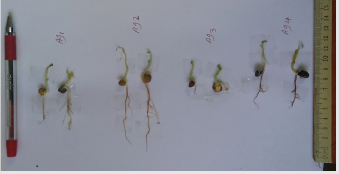
measure using a ruler. The controlled sets for germinations were
also carried out at the same time along with treated seeds (Figure
2).
Total germination percentage (GT) was calculated as Gt = (n/N ×100), where n = total number of germinated seeds (normal and abnormal) at the end of the experiment and N = total number of seeds used for the germination test.
B. Germination Speed Index (GSI)
Conducted concomitantly with the germination test, with a daily calculation of the number of seeds that presented protrusion of primary root with length ≥2 millimeter, continuously at the same time amid the trial. The germination speed index was calculated by Maguire formula [27]: aguire formula (1962):
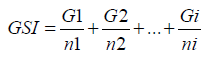
Where:
GSI = seedlings’ germination speed index;
G = number of seeds germinated each day;
N = number of days elapsed from the seeding until the last count.
The present study showed clearly that salinity had a negative
effect on the yield and its components of grass pea. It is well
known that seed germination provides a suitable foundation
for plant growth, development, and yield [30]. Increased salt
concentration caused a decrease in germination percent (Table 1).
Seed germination decreased as the doses increased. The Strong
reduction in germination (-47%) was observed mainly at the
highest level of salt concentration as compared to control treatment.
Delayed germination causes increased irrigation cost and irregular
and weak seedling growth in the establishment of legume crops.
Relevant results were reported by Gunjaca and Sarcevic [31] and
Almansouri et al. [32]. They reported that increasing osmotic
potential decreased water uptake and slow down germination
time. The average time of germination increases with increasing
levels of salinity. In view of mean germination time, there was a
considerable increase in this character at 0 (as control), 8 and 16
DS/m salinity levels as compared to the others. Emergence was
significantly affected by salinity levels. Moreover, many researchers
have reported developmental delay of seed germination at high
salinity [33]. The germination rate decreased as salt concentration
increased to a 16 dS/m and delayed for the high salt dosage (Table
1). Since higher salinity limited water absorption, it has prevented
nutrient assimilation, as a result, germination rate declined with
increasing salinity. The findings from this study were like to the
findings of Kaydan and Yagmur [34] and Akhtar and Hussain [35].
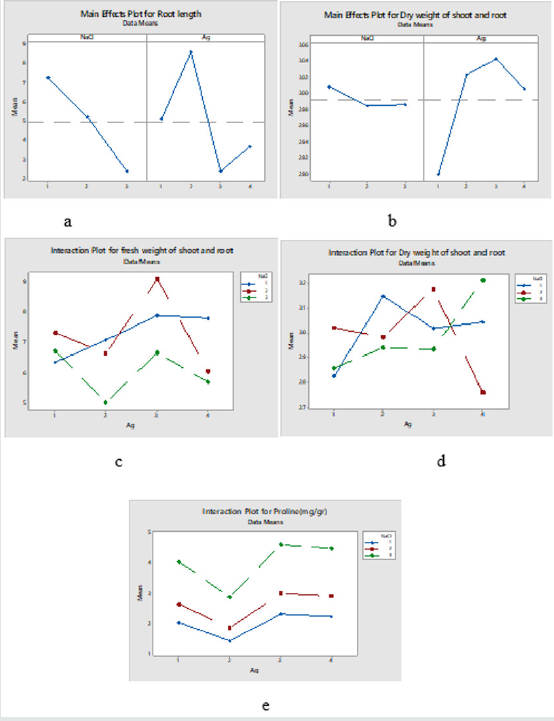
Proline was studied in numerous works dealing with plant selection against abiotic stresses such as dry and salinity [39,40], and it may play a defensive part against the osmotic potential produced by salt [41,42]. The proline substance of the expanded with the NaCl concentration of the culture medium. At 16 dS/m NaCl, the proline concentration appeared a huge increment in reaction to salt stress, although the activity of the roots at this concentration was negligible, with no grateful longitudinal development. Proline, which happens broadly in higher plants and collects in bigger sums than other amino acids [43], regulates the aggregation of useable N. Proline collection normally occurs within the cytosol where it contributes significantly to the cytoplasmic osmotic alteration [44]. It is osmotically very active and contributes to membrane stability and mitigates the impact of on NaCl cell membrane disturbance [45]. In the present experiment application of Ag NPs enhanced seed potential by increasing the characteristics of seed germination (Tables 1 & 2). The results showed that the impact of Ag NPs was significant on germination percentage in P≤0. 05. The results about of this test appeared that utilization of Ag NPs nanoparticles can increment the germination in grass pea. Seed germination results indicate that Ag Nanoparticles at their lower concentrations advanced seed germination and early seedling growth in grass pea, anyway at higher concentration showed slight antagonistic impacts. Parameters of seed germination were expanded with increasing levels of Ag NPs up to 10 ppm. Among the treatments, application of 10 ppm of Ag NPs proved best by giving the highest values for percent seed germination, germination rate and germination mean time. It is well watched that the exogenous application of Ag NPs decreased the reduction of germination resulted from salt treatments. In the interim, the control treatments of salt and Ag nanoparticles gave the tallest plants contrasted with the other studied treatments. Darvishzadeh et al. [21] found that the utilization of Ag Nano particles at the concentration of 40 mg.kg-1 prompted the increases in germination percentage and improved the resistance to salinity conditions in basil. The proline content increased with increasing severity of salinity stress. Additionally, proline content significantly (P.0.01) increased when silver nanoparticles were applied in connected in serious saline stress in comparison without silver nanoparticles (Figure 3).
Salt stress through enhancement of osmotic pressure leads to the
decrease of germination percentage, germination rate, germination
index and an increment in mean germination time of Lathyrus
sativus seeds. For overcoming the negative impacts of salinity on
the plant growth and yield can be to attempt to new strategies. The
dry and fresh weight of seedlings diminished as seedling length
declined with increasing salinity levels since root number, shoot
number, root length and shoot length decreased essentially. Results
demonstrate that Ag NPs at lower concentration enhances seed
germination, promptness index, and seedling growth. The positive
effect of Ag on physiological properties was in conditions that the
plant grew under salt stress was more increasingly exceptional in
examination with the conditions that plant grown under normal
conditions. The results of this study showed that Ag can be involved
in the metabolic or physiological activity in higher plants exposed
to abiotic stresses.
I would like to thank the Research Center for Plant Sciences,
and Dr. Jafar Nabati for providing the necessary facilities.
Abstract
Keywords: Ag nanoparticles; Salinity; Germination Stages; Grass Pea; Lathyrus Sativus L.
Introduction
Lathyrus Sativus L. (Grass pea) is an annual pulse crop belonging to the Fabaceae family and Vicieae tribe [8]. Grass pea has a long history in agriculture. The crop is an excellent fodder with its reliable yield and high protein content. This plant is also commonly grown for animal feed and as forage. The grass pea is endowed with many properties that combine to make it an attractive food crop in drought-stricken, rain-fed areas where soil quality is poor and extreme environmental conditions prevail [9]. Despite its tolerance to drought it is not affected by excessive rainfall and can be grown on land subject to flooding [10,11]. Compared to other legumes, it is also resistant to many insect pests [12-15]. Nanoparticles (NPs) are wide class of materials that include particulate substances, which have one dimension less than 100 nm at least [16]. The importance of these materials realized when researchers found that size can influence the physiochemical properties of a substance e.g. the optical properties [17]. NPs with different composition, size, and concentration, physical/ chemical properties have been reported to influence growth and development of various plant species with both positive and negative effects [18]. Silver nanoparticles have been implicated in agriculture for improving crops. There are many reports indicating that appropriate concentrations of AgNPs play an important role in plant growth [19,20]. The application of Nano silver during germination process may enhance germination traits, plant growth and resistance to salinity conditions in basil seedlings [21]. The use of Silver Nanoparticle on Fenugreek Seed Germination under Salinity Levels is a recent practice studied [22]. Nanomaterials have also been used for various fundamental and practical applications [23]. Although the potential of AgNPs in improving salinity resistance has been reported in several plant species [24,25], its role in the alleviation of salinity effect and related mechanisms is still unknown. Therefore, the main objective of this work was to study the effect of Silver Nanoparticles on salt tolerance in Lathyrus Sativus L.
Material and Methods
Figure 1: Silver Nanopowder, Coated with ~0.2wt%
PVP (Poly Viny Pyrrolidone) surfactant for low oxygen
content and easy dispersing. True density: 10.5 g/cm3
Purity: 99.99% APS: 20 nm SSA: ~18-22 m2/g Color: black,
Morphology: spherical.
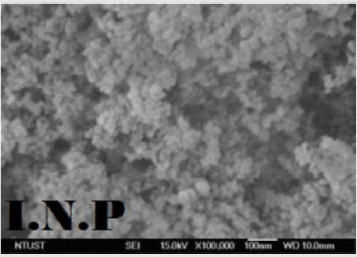
Figure 2: Effect of Ag Nanoparticles on Germination
Stages of Lathyrus Sativus L. in Salinity level( 8 dS/m
NaCl).
Parameters Measured in this Study were:
A. Germination StagesTotal germination percentage (GT) was calculated as Gt = (n/N ×100), where n = total number of germinated seeds (normal and abnormal) at the end of the experiment and N = total number of seeds used for the germination test.
B. Germination Speed Index (GSI)
Conducted concomitantly with the germination test, with a daily calculation of the number of seeds that presented protrusion of primary root with length ≥2 millimeter, continuously at the same time amid the trial. The germination speed index was calculated by Maguire formula [27]: aguire formula (1962):
Where:
GSI = seedlings’ germination speed index;
G = number of seeds germinated each day;
N = number of days elapsed from the seeding until the last count.
Root and Shoot Length
Root length was taken from the point below the hypocotyls to the end of the tip of the root. Shoot length was measured from the base of the root- hypocotyl transition zone up to the base of the cotyledons. The root and shoot length were measured with the help of a thread and scale.Seedling Vigour Index
The seedling vigor index was determined by using the formula given by Abdul baki and Anderson [28].Fresh and Dry mass
The fresh mass was quantified through weighing on precision scale, and the dry mass was determined through weighing on a precision scale after permanence of the material in a kiln with air forced circulation, at a temperature of 70°C, until indelible weight. At the ending of the experiment, At the end of the experiment, radical and plumule length and fresh weight measured. Plants were placed in the oven at 70°C for 48 h and weighted with sensitive scale.Proline Contents
Proline was determined spectrophotometrically following the ninhydrin method described, using L-proline as a standard [29]. Approximately 300 mg of dry tissue was homogenized in 10ml of 3% (w/v) aqueous sulphosalicylic acid and filtered. To 2ml of the filtrate, 2ml of acid ninhydrin was added, followed by the addition of 2ml of glacial acetic acid and boiling for 60 min. The mixture was extracted with toluene, and the free proline was quantified spectrophotometrically at 520nm from the organic phase using a spectrophotometer. Statistical analysis each treatment was conducted, and the results were presented as mean ± SD (standard deviation). The results were analyzed by one-way ANOVA with used Minitab Version 16.Results and Discussion
Table 1: The interaction effect of NaCl and AgNPs on Germination
Speed Index.

Table 2: Analysis of variance of the measured traits.
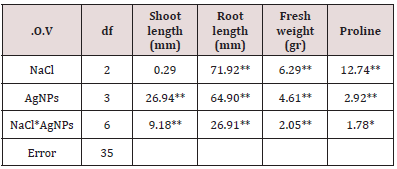
Shoot fresh weight was significantly influenced (P<0.05) by
salinity levels. The highest shoot fresh weight was obtained from
0dSm salinity level while the lowest weight was at 16dSm. Shoot
fresh weight significantly decreased as salinity level increased
above 8dSm (Table 2). Salinity stress significantly (P<0.05) affected
shoot dry weight as the salt concentration dosage increased. Shoot
dry weight significantly decreased in salt levels over 8dSm. When
the salinity level was raised above, the proline content increased
in grass pea. Culturing excised roots has demonstrated to be a
really great test show for the early detection of tolerance to abiotic
stresses such as saltiness [36-38].Proline was studied in numerous works dealing with plant selection against abiotic stresses such as dry and salinity [39,40], and it may play a defensive part against the osmotic potential produced by salt [41,42]. The proline substance of the expanded with the NaCl concentration of the culture medium. At 16 dS/m NaCl, the proline concentration appeared a huge increment in reaction to salt stress, although the activity of the roots at this concentration was negligible, with no grateful longitudinal development. Proline, which happens broadly in higher plants and collects in bigger sums than other amino acids [43], regulates the aggregation of useable N. Proline collection normally occurs within the cytosol where it contributes significantly to the cytoplasmic osmotic alteration [44]. It is osmotically very active and contributes to membrane stability and mitigates the impact of on NaCl cell membrane disturbance [45]. In the present experiment application of Ag NPs enhanced seed potential by increasing the characteristics of seed germination (Tables 1 & 2). The results showed that the impact of Ag NPs was significant on germination percentage in P≤0. 05. The results about of this test appeared that utilization of Ag NPs nanoparticles can increment the germination in grass pea. Seed germination results indicate that Ag Nanoparticles at their lower concentrations advanced seed germination and early seedling growth in grass pea, anyway at higher concentration showed slight antagonistic impacts. Parameters of seed germination were expanded with increasing levels of Ag NPs up to 10 ppm. Among the treatments, application of 10 ppm of Ag NPs proved best by giving the highest values for percent seed germination, germination rate and germination mean time. It is well watched that the exogenous application of Ag NPs decreased the reduction of germination resulted from salt treatments. In the interim, the control treatments of salt and Ag nanoparticles gave the tallest plants contrasted with the other studied treatments. Darvishzadeh et al. [21] found that the utilization of Ag Nano particles at the concentration of 40 mg.kg-1 prompted the increases in germination percentage and improved the resistance to salinity conditions in basil. The proline content increased with increasing severity of salinity stress. Additionally, proline content significantly (P.0.01) increased when silver nanoparticles were applied in connected in serious saline stress in comparison without silver nanoparticles (Figure 3).
Figure 3: Effect of interaction between ag nanoparticles and salinity on germination stages of Lathyrus Sativus
L. a - Main effects
plot for Root length (mm); b - Main effects plot for dry weight of shoot
and root (gr); c - Interaction Plot for fresh weight of shoot
and root (gr); d - Interaction Plot for dry weight of shoot and root
(gr); e - Interaction Plot for Proline (mg/gr).
Conclusion
Acknowledgment
For more Lupine
Publishers Open Access Journals Please visit our website:
http://lupinepublishers.us/
For more Open Access Journal on Environmental and Soil Sciences articles Please Click Here:
https://lupinepublishers.com/environmental-soil-science-journal/
http://lupinepublishers.us/
For more Open Access Journal on Environmental and Soil Sciences articles Please Click Here:
https://lupinepublishers.com/environmental-soil-science-journal/
To Know More About Open Access Publishers Please Click on Lupine Publishers


