Lupine
Publishers- Environmental and Soil Science Journal
Abstract
The southern limits of the distribution of the Snow Bunting Plectrophenax nivalis
in Eurasia are determined by the light regime
of the region - outside the zone of the polar day the birds will not
come to a state of sexual activity. Northern limits of the range
of Snow Bunting in the modern climate of the Arctic is not. The limits
of Penetration to the North of the Horned Lark Eremophila
alpestris glasses are determined by a set of biotopic, fodder and
temperature minima, allowing to penetrate into the Arctic, but not
to master most of it. The southern limits of distribution of the
Red-throated Pipit Anthus cervinus are limited by the zone of the
polar day defining maturation of gonads, mountain tundras of the polar
Urals and bogs of the West Siberian plain. The Meadow
Pipit Anthus pratensis has no ecological adaptations to the
subarctic conditions, but develops its southern half, moving along the
forest-tundra and shrubby tundra to the East, which is facilitated by
the warming of the climate in Western Siberia. The prospects
of changing species habitats in a changing climate are discussed.
Introduction
The biosphere approaches critical for the animal and vegetable
world of the period of rapid increase renesemee temperature. The
likely consequence of” global warming “ for the North of the Ural
region will be the promotion of taiga in the forest-tundra, foresttundra-
in the tundra zone, the displacement to the North of the
tundra subzones, the disappearance or reduction of the Arctic
deserts. All this has already been observed in the period of thermal
maximum 9-5 thousand years ago [1]. Changing landscapes will
be accompanied by changes for the animals inhabiting them. As
forest-tundra-tundra strip is the world of birds (177 species of
terrestrial vertebrates 215 of the Polar Urals and Peninsula Yamal),
changes in the greatest measure will affect this group the possible
advancement to the North common species, kinds, mastering the
sub-Arctic, the retreat to the North of the species-subarctic and
Arctic species. At the same time, there may be no direct connection
between habitat changes and changes in distribution and shift
of habitat boundaries. For example, the fauna of the waterfowl
forest-tundra lakes of the Lower Ob differs from the fauna of the
tundra lakes Of the middle Yamal [2] in the absence of differences
or insignificance of differences between the lakes. The aim of this
work is to generalize the data of observations and experiments on a
number of Passeriformes species in the Polar Urals, Lower Ob and
Yamal Peninsula to predict changes in the range boundaries within
the region.
Study Area
The study of birds started at the forest-tundra the hospital,
“Harp”, located 13 km from the town of Labytnangi (66°30N
66°25E.), continued in the polar Urals (the Sob ‘ hospital, 66°40N
60°50E.), then research was moved to the valley of the Ob river, on
the left a native beach in the vicinity of Oktyabrsky 5 km below the
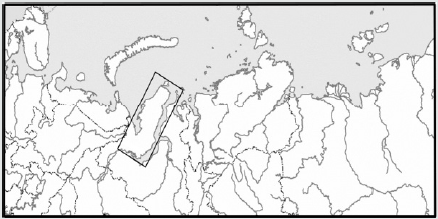
city of Labytnangi (Figure1). The boundaries of the ranges of the
species discussed on the Yamal Peninsula were determined during
expeditions in 1974-1982 to the southern, Middle and Northern
Yamal.
Figure 1: Location of the research area.
Method of Research
On the inpatient Sob and October, we carried out the trapping
of passerines lines spider nets and large traps. On the test sites,
nests were found, ingots were banded with aluminum and colored
rings (more than 1,300 Chicks of 8 species were ringed), and the
movement of broods was observed, and later - for individual birds
marked with colored rings. All captured birds underwent a single
complex of in vivo testing: weight, fatness, wing length, sex, age was
determined; the state of plumage was described according to the
known technique [3]. Analysis of the replacement sequence of the
entire plumage requires the division of the molting process into a
number of stages- stages. When you complete the molt over the
stage taking the period from the loss of a single primary feather
up to the moment of loss following [4]. In this case usually stands
11 stages, with a partial molt stage are to participate in various
pteryla [5]. Depending on the number of pteryla, which is replaced
by feathers in the partial moult allocate from 2 to 8 stages.
Experimental work was carried out in 1985-1989 and 1999-
2012 on birds taken from nests found in the Lower Ob and middle
Yamal. From 10-14-day-old Chicks or adult birds to Supplement
with formula or fed artificially. The aim was to form three groups
of birds of 5-20 individuals: short-day photoperiod (16C:8T),
photoperiod, natural for the latitude of the Polar circle and longday
photoperiod (24C:0T). The purpose of these studies is to
study the features of photoperiodic and temperature control of the
summer part of the annual cycle of birds with different types of
development of high latitudes - penetrating the Subarctic, mastered
the Subarctic, mastered the Subarctic and the Arctic. In the
processing of quantitative materials used conventional statistical
methods to assess the reliability of differences used student
criterion. Differences were considered significant At p < 0.05. All
calculations are performed in Microsoft Excel 2003 and Statistica V.
6.0 (StatSoft, Ink., 1984-2001).
Results and Discussion
Environmental Determinants of Latitudinal Boundaries
of the Habitats of the Horned Lark Eremophila alpestris
and Snow Buntings Plectrophenax nivalis
The southern boundary of the habitat of the Horned Lark
Eremophila alpestris and Snow Buntings Plectrophenax nivalis on
the maps of the Yamal Peninsula conducted at the same points
parallel to the southern border of shrub tundra. On the Ural ridge,
the area of the Northern subspecies of the Horned Lark Eremophila
alpestris (Figure 2) does not extend beyond the latitude of the Polar
Circle (66°30´N). Most South registration litter of Snow Buntings
Plectrophenax nivalis in the Subpolar Urals in the hillside Sable
(64°30´N) [6]. To the North, the occurrence of these birds in the
mountains increases, at the end of the Polar Urals, at the outcrops of
rocks, the Snow Buntings Plectrophenax nivalis are ubiquitous [6].
On the plain of the Yamal Peninsula, the Horned Lark Eremophila
alpestris are found from the southern subarctic tundra to the Arctic
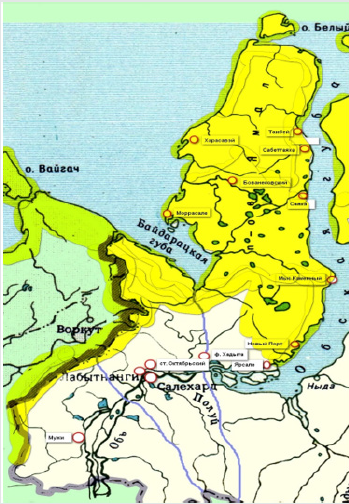
tundra of the Northern tip of Yamal and The white island. Snow
Bunting Plectrophenax nivalis in the wild, on the plains of Yamal, is
found in the Northern half of the subzone of the Arctic tundra and
on the island of White in accordance with Figure 3, mainly, along
the coasts [7].
At the Bottom Ob the first Snow Buntings Plectrophenax
nivalis flew between 24.03 and 2. 05, average 7.04 (n = 39). Night
temperatures these days fell to -23°C, the day was somewhat
warmer. The average temperature in the first decade of April
was -15.9° ± 1.2°C. (n = 10) the Flight lasted until the end of May
- beginning of June. The first flocks included only males, the last
- females with a small share of males. No changes in the start of
the flight over the past 40 years have been detected, in contrast to
the terms of the flight of Horned Larks Eremophila alpestris. In the
70’s-the first half of the 80’s. the Larks of Eremophila alpestris are
met between 1.05-29.05, the average date of the first meeting is
13.05 (n=11), the mass flight was observed before the ice drift and
intensive snow melting on plakor. By the mid-1980s, the migration
of this species had shifted from the first half of May to the second
half. In the 90-ies [8] arrival of these larks Eremophila alpestris
began between 11.05-30.05, the average date - 22.05 (n = 13).
Currently, Eremophila alpestris‘ horned larks often fly over an icefree
river and snow-free tundra. The average daily temperature on
the day of the first registration of Horned Larks in the period 1978-
1983 was 9°C ... -3.1°C, an average of 1°C (n = 5).
Figure 2: Distribution of Eremophila alpestris in the Lower Ob-region and Yamal.
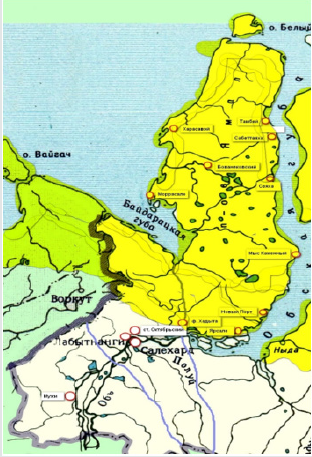
Figure 3: The distribution of
Plectrophenax nivalis in the Lower Ob- region and in Yamal.
Nesting sites at the polar stations of the Middle and Northern
Yamal males Snow Buntings Plectrophenax nivalis held in April.
Females arrived much later, in May. Migrating flocks Of Eremophila
alpestris larks included birds of both sexes; some pairs may be
formed on migration. Snow Buntings Plectrophenax nivalis from
pairing to the laying of the first egg as the weeks pass, larks-days.
Despite the early occupation of the nesting areas, the bunches
of Plectrophenax nivalis laid eggs in time, common with other
passerines, including larks Eremophila alpestris, in some years
somewhat earlier. In Northern Yamal oviposition was found in
the nests of Plectrophenax nivalis and Lapland Longspur Calcarius
lapponica in 1974 he started and 17.06 22.06 (calculated according
to the age of the Chicks). In the polar Urals, south of the Arctic circle,
the Plectrophenax nivalis fledglings occurred after 10.07. 2000, and
fledglings of other birds, the estimated start date of oviposition of
Plectrophenax nivalis June 2-3, [6]. On the middle Yamal in 1990,
the author observed simultaneously fledglings plantain Calcarius
lapponica, Motacilla alba, Plectrophenax nivalis and Eremophila
alpestris between 5-9.07. From the Passeriformes of Yamal, the
Horned Larks of Eremophila alpestris had a minimum laying size of
2-5 eggs, with an average of 4.12 ± 0.06 eggs (n = 98). 4-7 eggs were
found In the nest of Plectrophenax nivalis, with an average of 5.42
± 0.18 eggs (n = 19). Differences between species are significant at
p ≤ 0.05. Larks Eremophila alpestris begin to hatch from the 2nd
egg when laying 3-4 eggs. Duration of incubation from the first egg
to the first nestling is 11-14 days, average 12.8 ± 0.42 days (n=7);
duration of nestling - 9-12 days, average 10.4 ± 0.6 days (n = 9). The
total duration of the period from the first egg to the last nestling is
21-24, on average 22.3 ± 0.48 days (n=6). For North Рasseriformes
this is the shortest period. The Horned Lark Eremophila alpestris is
the only one of the Passeriformes subarctic species, part of the pairs
of which after feeding the Chicks of the first brood build a new nest
and feed the second brood. Nenets name of the species “Sidnigy”
translates as “nesting twice.” On the middle Yamal Peninsula of 8
ringed with coloured rings couples twice on his site bred 2 pairs
[2]. In case of loss of the first nest birds also nest again on the site.
After leaving the nest, the broods were fed for a decade, so the
breeding season of Eremophila alpestris, considering the second
clutch in the subarctic tundra of Yamal, lasts more than two months
(65-75 days) and ends in mid-August. The breeding season of the
Snow Buntings Plectrophenax nivalis lasts less than two months
(35-45 days). Females began incubation with the last egg, some
earlier; incubation lasts 12-13 days, nestlings sit 9-15 days, more
often 12-13 days. The total duration of the period from the first egg
to the departure of the last chick is 27-33 days.
In the annual cycle of larks Eremophila alpestris one molt,
postjuvenile the first years, postnuptial adults in the breeding
range. In the annual cycle of Snow Buntings Plectrophenax nivalis
two molting: postjuvenile young, postnuptial adults in the breeding
range, prenuptial moult from immature and adult individuals in the
field of hibernation. Postjuvenil molt at larks Eremophila alpestris
full. Examination of the two extracted on the middle Yamal young
birds, and inspection of the tail of the carcasses of young North lark
(n = 5) of the ornithological collection of the Zoological Museum
of Moscow state University shows that the flight feathers in birds,
Northern populations are replaced completely, probably completely
replaced by contouring and feathering, at least in birds, moulting in
normal terms. The age of the beginning of molting is not established,
but the first-year Eremophila alpestris caught in the area of Seyaha
settlement (70°10N 72°30E) 1.08 was at the 4th stage of molting
(from 11 stages). Based on the terms of hatching in this area, the
age of the bird was 30-35 days, ie molting he started at the age of
not older than 30 days. Replacement of plumage in Horned Larks
Eremophila alpestris, due to the large volume, cannot last less than
45-55 days. At birds of the second brood, (hatching 20.07-30.07) at
duration of a molt of 40-45 days, for timely departure the beginning
of a molt has to be shifted on age 25-30 days. Probably, the timing
and pace of this shedding is controlled by the photoperiod, i.e.
the shorter the day, the sooner it starts and ends faster, which is
especially important for the second brood. Molting individual’s
Balkan subspecies of the horned lark Eremophila alpestris began in
38 days (26.07), lasted 80 days, to 14.10. [9].
Viewing the carcasses of adult northern larks Eremophila
alpestris from the ornithological collection of the Zoological
Museum of Moscow University (n = 13) and a small number of
birds shot on the middle Yamal (n = 5) indicate the beginning of
post-marital molting from 10.07 to 10.08. The average calculated
duration of molting - 68 days, beginning -2.07, end - 7.09. In birds
with a second clutch, shedding should be combined with feeding the
Chicks. In a cage of four birds contained in the spring. Two males of
Eremophila alpestris began moulting in the second decade of July,
two - in the third, and finished it in the third decade of September,
after 65-75 days. The female began molting 12.07, finished after 68
days, 18.09. The post-marital molt of the Balkan subspecies began
on 22.06 and ended on 92 days, on 22.09 [9]. Postjuvenile molt
of Plectrophenax nivalis partial. As a result of its individual
wears
a mixed first winter outfit consisting of a youthful flight feathers
of the wing, the wing, tail feathers and succeeding in a result of
shedding of part of the wing coverts, contour feathers of the head
and torso. In a cage under short-day birds have not replaced the
large upper coverts of the secondaries, i.e. the completeness of
molt is determined by photoperiodic conditions. In the natural
photoperiod of middle Yamal, molting of young birds began at the
age of 33-44 days on average 37.4 ± 2.1 days (n =5), between 24.07-
30.07. When the photoperiod 16C:8T Snow Buntings have started
moulting to 29, 31, 32 days, an average of 30.7 days. Despite a small
sample, there is reason to believe that the timing of the molt is
controlled by the photoperiod, because with a short day molt began
earlier. The molting rate is also controlled by the photoperiod.
Under lighting conditions close to the natural Middle Yamal birds
replaced plumage for 48-51 days, an average of 49.4 ± 0.6 days.
and finished it between 10.09-15.09. With a short day of molting lasted
37, 39, 40 days, an average of 38.7 days, ie. the shrinking day
stimulates not only a shift in the timing of the beginning of molting
on earlier dates, but also earlier its end (24.08-30.08) by reducing
the number of replaced feathers. Very early on 5th or 6th molt
stages (7 stages), poultry has gained the “average” fat reserves. In
early October, 3 young birds were examined in the forest-tundra.
Two of them have finished shedding, one was in the last stage; in
the middle of October all 6 examined birds were in the new feather.
The period of post-juvenile molting in the population of Yamal
punches of Plectrophenax nivalis continues 2-2.5 months.
Postnuptial moult of Plectrophenax nivalis full. In enclosures
hospital October Snow Buntings (n=7) started moult between
12.07-25.07 average date 18.07. In Yamal male moult apparently
begins in the third decade of July, but some birds can start it in the
second decade. Perhaps some males, like other Northern Bunting
[10], started the replacement of feathers prior to fledging from
the nest; with supplemental foods juvenile moult must combine
all males and some females because of the summer time, it
remains small. In Greenland [11] some moulting males fed female
and nestlings always combined with supplemental foods moult
juveniles; females always started moult after leaving the nests
hatchlings. Molting of Plectrophenax nivalis aviary punches lasted
51-65 days, on average-57.8 ± 2.0 days (n=7), which is twice the
duration of molting of Plectrophenax nivalis in Greenland (720 N)
- 28 days [11]. Usually in the aviary molt is somewhat delayed, but
two-fold differences in the rate of molting Plectrophenax nivalis
indicate that the Yamal birds shed really slower than the Greenland.
Starting molting in late July - early August, they finished it in mid-
September, at the same time with young birds. However, they did
not lose the ability to fly, unlike the birds of Greenland [11]. Through
the Bottom Ob the adult birds are flying without a trace of molt.
Departure of larks Eremophila alpestris from the forest-tundra
falls on the period from 18.09-15.10. Snow Buntings Plectrophenax
nivalis appear in the forest after the first snowfall, in the third
decade of September - early October. The main period of migration
Plectrophenax nivalis mid-late October, ends in November. Near
the city of Labytnangi the average duration of the migration period
of Plectrophenax nivalis 23 days. The unifying features of the
ecology of the studied species include, first of all, high resistance
to low air temperatures. It is supported by wintering in the lowsnow
continental zone, where night temperatures -20°... -30°C are
very common. Arriving in spring to the North of the subarctic and
Arctic, Snow Buntings Plectrophenax nivalis and larks Eremophila
alpestris do not go beyond the lower limits. Resistance to low
temperatures and, probably, dense hatching, allows early risers to
keep the eggs and Chicks in a relatively shallow socket with low
thermal insulation qualities. By the Ural mountains Snow Buntings
penetrate to the South to the highlands without going down to the
foothills, where there are mountain tundras, but apparently too
warm. Horned Larks need to better endure summer temperatures
than Snow Buntings because other species inhabit the lower
latitudes, but in the subarctic region South of the July isotherms
12°C they do not nest. High density nesting of Eremophila alpestris
within July isotherms of 5-10°C, Plectrophenax nivalis - 2-5°C . No.
Beetles [12] revealed similarities to the southern boundary of the
area of the Eremophila alpestris with the isotherm of July 10°C.
Perhaps in the Arctic lark Eremophila alpestris and Plectrophenax
nivalis for stimulation of oogenesis enough temperatures close 0°C.
or required additional signals (ready biotope, abundance of feed).
A significant role in the formation of the fauna of the subarctic
is played by the duration of the frost-free period. When feeding two
broods in part of the larks Eremophila alpestris breeding period
should last up to 2 months. On the white island and on Novaya
Zemlya (73°N) the second brood is probably not present, because
the frost-free period is short there. In Western Siberia, the area of
larks Eremophila alpestris is in the limits of frost - free period 70
days (68°N) - 35 days (75°N.), that in the subarctic tundra allows
you to feed two broods in the Arctic-one.
A characteristic feature of high latitudes - summer polar day.
Northern migratory birds with increasing length of the day faced
on the wintering grounds and during spring migration. But already
on approach to a Polar circle they get to conditions of constant 24-
hour day. The reduction of the day length in the subarctic begins
much later than in the temperate latitudes, in the middlelate
summer, and in the Arctic - in late autumn. In the spring-autumn
part of the annual cycle of Northern birds there are two critical
points depending on the length of the day: the period of gonad
formation and the period of molts. For full maturation of gonads,
based on the photoperiod of the extreme southern nesting point
in the circumpolar Urals, Plectrophenax nivalis need a short stay
(exposure) at the photoperiod 24C: 0T (occurs only during the
summer solstice), so nesting should begin at the end of June. Indeed,
G. Boyko [13] in XP. The saber (the southernmost nesting point,
64°30N60°E), met several adult punches of Plectrophenax nivalis
with ingots 3.08, i.e. the oviposition of these birds began after the
summer solstice. North of the Arctic circle, where the polar day
begins in the first decade of May, the registration of broods falls on
the first - second decade of July, birds were exposed long before the
summer solstice. On the Arctic Islands, where the polar day lasts
almost six months, the photoperiod does not prevent the early start
of egg laying, but there are no external nesting conditions: weather,
fodder, biotopic. Horned Lark for the maturation of the gonads is
necessary more long stay under continuous light. In spring the
birds fly over the forest-tundra at the photoperiod of 24C: 0T to the
southern border of the area in the tundra zone, where the gonads
reach full maturity. The period from the appearance of an individual
in the polar day zone to arrival at the nest site in the shrub tundra,
due to the very slow migration through the forest tundra, lasts a few
days; to the Arctic tundra larks Eremophila alpestris fly 5-10 days
(based on the dates of arrival in North Yamal). The likely duration
of exposure 24-hour day for sexual activity-3-5 days.
Molt of Snow Bunting in the polar Urals and flows starts with
shrinking the bottom, in the Northern sub-Arctic and Arctic-at a
constant 24-hour day. Photoperiodic control of the time and rate
of post-juvenile molt is adaptive to the light conditions of the polar
Urals, where in August the day is rapidly decreasing, but in the
Northern and main parts of the area photoperiodic control does
not work, i.e. there is no need for such a reaction. Age and rate of
molting in the bottom of the Arctic controlled by the endogenous,
but the young from the second egg laying and their parents with
the onset of dark nights enabled the photoperiodic reaction. In
the Arctic, due to the need for departure in late September - the
first half of October, but before the beginning of the dark nights
in mid-October, shedding should occur accelerated endogenously
controlled pace. In this regard, an interesting 28-day duration
post-nuptial moult, Plectrophenax nivalis in Greenland. G. Green, R.
Summers [11] in discussing such moult rates suggested that they
increase to the North, because Greenland, unlike Iceland, punches
Plectrophenax nivalis lose the ability to fly due to the rapid moult of
the flight feathers, which “indicates further adaptation to a shorter
season at higher latitudes.” The moult of Eremophila alpestris
in different photoperiodic conditions has not been studied, but
probably in the southern tundra the terms and rates of molts are
controlled by the decreasing day, and in the conditions of the long
polar day (in the Northern subarctic and Arctic tundra) the terms
and rates are controlled endogenously, by the internal rhythm. Only
in this case the larks Eremophila alpestris at 75°N (range limit on
the island of Novaya Zemlya) are able to finish a complete molt and
fly away for the winter in the middle-end of September.
Ecological differences between species belong to the nesting
period. Acquiring resistance to low summer temperatures and
adaptation to the light regime, larks Eremophila alpestris did not
change the requirements for breeding habitat, have not started to
build a warm and sheltered from the winds of the nest, but for food
for the Chicks learned to fly in the floodplain, to find earthworms,
larvae and imago Tipulidae, larvae of sawflies, i.e. the preference
for large invertebrates. The expansion of their range at the expense
of the Arctic Islands prevents the whole range of Arctic conditionsthe
lack of suitable for nesting biotopes, the lack of the required
number and mass of large invertebrates, a short period of positive
temperatures. Plectrophenax nivalis are distinguished by nesting in
shelters and a large nest, which protects the clutch and brood from
low temperatures, a wide range of feed biotopes, from garbage
dumps to sea shores and the composition and size of invertebrates
- from the tailings to beetles and sea crustaceans. The nesting of
Plectrophenax nivalis on all Arctic Islands indicates that there are
currently no limiting factors for the species.
Environmental Factors that Determine the Latitudinal Boundaries of the Areas of Red-throated Pipit and Meadow
Pipit
Red-throated Pipit Anthus cervinus is associated with the
origin of the Subarctic, its nesting area is mostly limited to the
forest-tundra strip, sometimes penetrates into the Northern taiga.
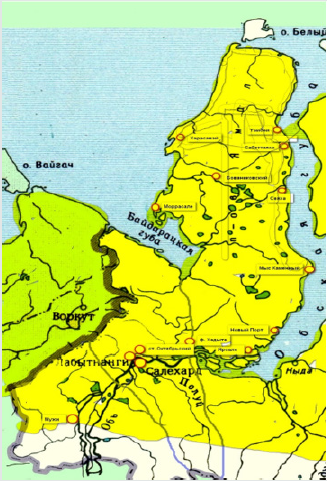
In our area nests (Figure 4) in the band from the Northern tip
of Yamal (73°N) to the Western Saleda ridge (65°N) in the polar
Urals. Tundra Red-throated Pipits everywhere, with the exception
of riparian forests, and avoided deciduous woodland of placore. In
the southern subarctic tundra, Anthus cervinus skates were found
in all biotopes, in the Northern subarctic tundras they were found
regularly in floodplains, and in open tundras on plains and on
the southern slopes of hills and ravines. In the South of the Arctic
tundra of Red-throated Pipits Anthus cervinus was recorded in dry
lichen tundra, cut by ravines of small streams and in areas of bumpy
rather dry tundra.
Figure 4: Distribution the Anthus cervinus in the Lower Ob- region and in Yamal.
Meadow pipit Anthus pratensis at the beginning of the twentieth
century. nesting to Salekhard (66°31N 66°53E), but not North; in
the middle of the century skates nesting in the middle reaches of
the river Pike (67°N) [14]. In 1974-1976 nesting Pipits greeted us
at the village of Mys Kamennyy (68°40N 73°10E.) and to the North,
the middle reaches of the R. Mardiah (69°50N.). But they were not
on the 70th latitude on the West coast near the polar station of
Marre-Sale, on the East coast near the village of Seyaha (70°10N
72°30E) and 30 km from the coast, in the middle reaches of the
Yasaveyaha river [2]. In 1988-1990 Meadow Pipits Anthus pratensis
continued to meet in the middle reaches of the river Mardiah, and
in 2006 they are found nesting in the vicinity of the settlement of
Seyakha [15]. Thus, over the last 100 years, the species has moved
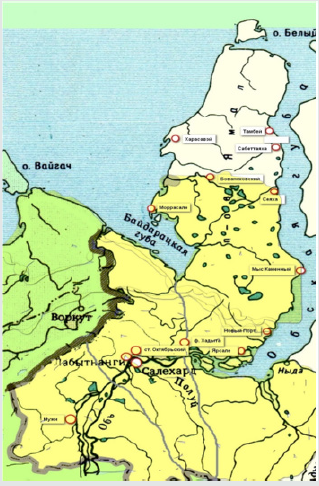
to the North by more than 300 km, to the 70th parallel (Figure 5). At
the same time, the area to the East is expanding. The Eastern border
of the Anthus pratensis nesting in the middle of the last century
was carried out along the Ob valley (63°50N).; somewhat later, the
species was found in the upper reaches of the Kazym and Nadym
rivers [16]. Currently, as a rare breeding species Meadow Pipit
Anthus pratensis found on the right tributary of the lower Pelvis-p.
Russian (67°20 n 82°E) [17].
Figure 5: The distribution of
Anthus pratensis in the Lower Ob-region and in Yamal.
The arrival of the first Red-throated Pipits Anthus cervinus in
a neighborhood of the city of Labytnangi in the period 1971-2014
was observed between 10.5-7.06. The earlier spring began, the
earlier the first birds appeared. The air temperature on the day
of registration of the first bird in the forest tundra was 0.1-5.8°C,
on average 2.3°C (n=6); in Yamal, the arrival also began at positive
temperatures. For the forest-tundra period 1970-2004. the average
date of the meeting of the first Anthus pratensis-25.05, the earliest
date-3.05.1982, late-4.06.1978. the air Temperature on the day of
the meeting of the first bird was 0.2°C...-11.4°C, an average of 3.0°C
(n = 8), in the late spring birds flew with the first wave of warm air.
Meadow Pipit Anthus pratensis always arrived before the Anthus
cervinus for 1-10 days. Easter S. [18] showed that in the Lower
Ob area of Meadow Pipits and Red-throated Pipits in 1986-2001. began to
arrive significantly earlier (P ≤ 0.05) than in the previous
15 years.
In Red-throated Pipit from the first in the season of birds
encountered before oviposition, forest tundra passed 13-20, an
average of 16.0 days (n = 8), in the middle Yamal this period lasted
7-13 days, an average of 10 days (n = 4). In the Meadow Pipit the
duration of the pre-breeding period in the forest-tundra, from the
first in the season encountered birds to the beginning of laying in
the forest-tundra reached 12-27 days, an average of 7 years-18.7 ±
2.1 days. Oviposition in Anthus cervinus began after 8-13 days, an
average of 9.8 days (n = 5) after the transition of the average daily
temperature through 0°C the average Daily temperature on the
day of the beginning of egg laying in the forest tundra in different
years was 6.0-11.5°C (n = 5). In the Lower Ob the earliest date of
the beginning of the period of egg laying by the Red-throated Pipit
Anthus cervinus 9.06. 1973, the latest-21.06.1972g, average 16.06.
(n = 5). On the Middle Yamal these dates are as follows: 5.06.1990
- 29.06.1987 and 1992, the average date is 14.06 (n = 9), on the
North Yamal 9.06.1988 - 1.07.1992 and 1994, the average date is
21.06 (n = 6). In some years, with the advance to the North, the
timing of the beginning of egg laying is also shifted to later dates.
In 1990 at the 69th parallel oviposition began 5.06, 70 10.06, in the
71st - 13.06. In other years, the delay in the beginning of the egglaying
season on the 71st parallel compared with the 69th was 4
(1988) - 15 (1991) days.
In the Lower Ob in 1971-1990 the first eggs in the nests of
Meadow Pipit Anthus pratensis appeared between 7.06.1989 and
18.06.1971, the average for 9 years of observations the date of the
beginning of oviposition-14.06. On the Middle Yamal Peninsula in
1974-1992 years and the earliest date of oviposition - 13.06.1989,
the beginning of masonry in Ob - 8.06.1989. The latest date the
beginning of masonry on the Middle Yamal - 19.06.1974, with the
beginning of oviposition in the Lower Ob - 16.06.1974. Masonry of
the bulk of females begins in the first 6 days: in the forest tundra 98
masonry of 112 (87.5%); in the middle Yamal 126 of 160 (78.7%),
in the North Yamal - 12 of 26 (46%). The total duration of the laying
season in the forest tundra is 14-21 days, average 16.8 ± 1.3 days (n
= 5), average 9.8 ± 1.0 days in the tundra of the middle Yamal (n =
9), 13-28 days in the Arctic tundra of the Northern Yamal, average
18.8 ± 2.9 days (n = 5). The stretch of the season connected with the
finding of subsequent clutches.
In the masonry of the Red-throated Pipit Anthus cervinus 2-7
eggs. In The lower Ob in the clutch was 5.34 ± 0.06 eggs (n = 209):
in the Northern Yamal the average size of the clutch was 5.46 ± 0.14.
The increase in masonry from the forest-tundra to the tundra Of
the Middle Yamal is highly significant (t ≤ 11.1) and is associated
with an increase in the proportion of masonry with 7 eggs, but
in the Northern Yamal masonry value decreases again due to the
reduction in the proportion of nests with 7 eggs. In the nests of
Meadow Pipit in the Lower Ob ‘ region and in the Southern Yamal
Peninsula was 5.41 ± 0.09 eggs (n = 101). On the Middle Yamal
there were 5.88 ± 0.06 eggs (n = 58). The differences are significant
(t = 4.7, P ≤ 0.01) due to the absence of clutches with 2-4 eggs in the
sample. Thus, both types of skates with promotion to the North, the
number of eggs in a clutch increase.
According to the results of instrumental measurements, the
female of the Red-throated seahorse Anthus cervinus starts to
incubate regularly after laying the 2nd-3rd egg with 5-6 eggs. The
duration of incubation from the last egg to the first nestling on 28
nests is from 10 to 13 days, on average 11.5 ± 0.15 days. Hatching
is stretched for 1-3 days, more often for 2 days, on average 1.8 ±
0.15 (n = 13). The Chicks sat in the nest 9-13, on average, 11.6 ±
0.29 days. (n = 26), ingots from large broods left the nest earlier.
The duration of the breeding season Anthus cervinus tundra 36-43,
on average, 38.8 ± 1.0 days. (n= 6). At the meadow ridge incubation
begins with the penultimate or last egg. From the last eggs before
the first Chicks in the control nests of meadow Pipits Anthus
pratensis took place 12-15 days, an average of 13.9 ± 0.19 (n=16).
In the nest the Chicks were sitting 9 to 14 days, on average 10.9±0.4
days (n = 16). The total duration of the breeding season at the Polar
circle latitude from the first egg to the departure from the control
nests of the last nestling in different years: 38-44 days, on average
- 41.5 ± 1.6 (n = 8). On the Middle Yamal the breeding season of
Anthus pratensis lasted 43-50 days, on average 46.7 (n = 3).
Up to 20-22 days of age, Anthus cervinus Red-throated Pipit
fledglings were in the area of the breeding area and were fed by
adult birds. The disintegration broods Red-throated Pipits occurs
at 23-25 days and the birds leave the nesting area in the process of
dispersion of the dispersion. Older this age re-caught 2 seahorses
at the age of 35 and 39 days. In the forest tundra adult Meadow
Pipits was worried at nesting sites until the beginning of August.
Of the 20 ringed Chicks in the nests in the area of the nesting area,
2 birds were caught at the age of 33 and 54 days, i.e. after the
disintegration of the broods, most of the young birds are included
in the dispersion spread, but some remain in the birth area for a
long time. Postjuvenile moult Red-throated Pipit partial, minimal
among the Northern Motacillidae completeness: replaced a part of
the contour feathers of the head and trunk down on apteryx and
some wing coverts. Postjuvenile molt Meadow Pipit partial, but
more complete than the Red-throated Pipit. Coverts moult of the
head and torso, grew up in the nest, and part of wing coverts, where
everyone is viewed on the secondary stages of molting birds were
replaced by a small upper-coverts of secondaries, upper and lower
opacity brush, wing-coverts, tertials coverts lower, secondary lower
coverts of secondaries.
The moult of the Anthus cervinus begins at an early age, in
birds
older than 20 days of age. Of the 11 skates ringed in nests and caught
at the age of 20-38 days, molting was 4 individuals: the horse at the
age of 25 days was at the 1st stage, at the age of 28 days at the 2nd
stage, 2 birds at the age of 33 and 38 days were at the 3rd stage.The
rest, at the age of 20-25 days did not shed. In experimental
conditions molting began in 22-25 days at a short day (23.4 ± 0.4;
n=8), in 24-25 days at natural (24.4 ± 0.2; n = 5) and 24-26 days
(25.0 ± 0.2; n = 9) at a long day, i.e. the age of onset of moult in
this
species is controlled by endogenous. Meadow Pipit Anthus pratensis,
ringed in nests and caught in nature at the age of 22-30 days, did
not start molting. Skates, fed and overexposed at the natural day,
began shedding at the age of 36-45, an average of 38.0 ± 1.4 days (n
= 6). Under short-day molt started no earlier than 27 (27 to 36 days,
averaging 31.8 ± 1.1; n = 8), the long - not later than 50 (45 to 50
days, averaging 46.7 ±.0; n = 5). The differences in the age of molt
onset are significant between all groups: short-day and natural day
(t-criterion = 4.04, P ≤ 0.01); natural day and long-day (t-criterion =
4.53, P ≤ 0.01); short-day and long-day (t-criterion = 10.1, P ≤ 0.01).
Thus, the timing of post-juvenile molting in meadow skates Anthus
pratensis controlled photoperiod, in contrast to the Anthus cervinus.
The rate of shedding is controlled by the photoperiodic
response in both species. Molt Meadow Pipits Anthus pratensis
under short-day regime molt lasted 30 to 36 days, averaging 34.0
± 0.8 (n = 8); natural 37-40 days, averaging 38.5 ± 0.8 (n = 5); the
long-day regime 40-55 days, averaging 45.0 ±1.6 (n = 9). The
differences are significant between the groups of short and long
days (t-criterion = 3.0, p ≤ 0.05). the period of post-juvenile molting
in the population of Red-throated Pipit Anthus cervinus of The lower
Ob should last 45-55 days. By the time of its completion, the young
skates fly away from the Lower Ob. Molt Anthus pratensis under
short-day molt lasted for 35-45 days, an average of 39.7 ± 1.2 (n =
8); natural 44-49 days, averaging 46.0±1.6 (n = 6); the long - 58-
62 days, averaging 59.5 ± 0.5 (n = 6). The differences are significant
between the groups of short-day and natural day (t-criterion = 3.15,
p ≤ 0.05); natural day and long-day (t-criterion = 8.08, P ≤ 0.01);
short-day and long-day (t-criterion = 15.2, P ≤ 0.01).
Young Red-throated Pipit usually started shedding without
leaving the nest surroundings and the last stages of shedding the
skates combined with migration. Migration from Meadow probably
starts after the completion of the moult, because in the third week
of September in the vicinity of Labytnangi appeared regularly
flocks are skates; in 1982, in the last five days of September caught
7 birds, 3 of them have finished molting, 4 were in new plumage.
Season postjuvenile shedding Anthus pratensis in the tundra lasts
2 months, a third longer than the Anthus cervinus. Full post-nuptial
molt in both species, Anthus cervinus partially simultaneously with
the feeding of the Chicks. In the second half of the molting period,
the skates partially lose their ability to fly [19]. According to the
results of the regression analysis, the average date of the beginning
of the post - marital molt of the Red - throated Pipit Anthus cervinus
falls on July 22, the end of the growth of the flight feathers-on August
19, the duration of the molt of the flight feathers-29 days, contour
plumage finishes molting not earlier than a week. The actual
duration of the post-nuptial moult is 37-45 days. It is necessary
to pay attention to high rates of replacement of flight feathers: in
25-30 days after its beginning birds are able to begin migration.
The slow rate of formation of contour feathers does not prevent
flights. The season of post-marital molting in the population of
red-throated skates Anthus cervinus of The lower Ob region lasts
45-50 days. Post-marital molting in Meadow Pipit Anthus pratensis
began in the second half of July - early August. The first shedding
pipit caught 23.07, the average calculated date of the beginning of
molting - 27.07; in the old plumage of birds caught up to 5.08. The
duration of molting in the first beginners of her skates 45-50 days.
Males, overexposed from spring (n = 4) in the aviary, shed 56-65
days, on average 59 days; female, taken with Chicks, completely
replaced the plumage for 49 days. The average end date of molting
in nature 3.09, the average duration of molting regression 39 days,
the duration of the season of post-marital molting 60-70 days.
Red-throated Pipits Anthus cervinus fly away from the forest
before the meadow. Maximum span in 1975 was observed 2.09. The
last meeting of the young birds on the tour in 1975 have on 17.09,
adults - 8.09, the departure period lasted about a month. In 1980
from the Enzor-Yakha and Baydarata rivers (68°15N 69°10°E) the
departure of red-throated skates Anthus cervinus ended in the last
days of August [20]. The departure of the Anthus pratensis begins at
the end of August and ends at the end of September. The most recent
meetings in the Lower Ob are 21.09.1980, 28.09.1982, 25.09.1984.
One flock met on the first snow. N. N. Danilov [21] attributed the
Meadow Pipit Anthus pratensis species have mastered the southern
sub-Arctic. Currently, in Western Siberia, the species is developing
the Northern subarctic And quite well mastered the “middle”
Subarctic-sub-zone of the subarctic tundra of Yamal and Tazov
Peninsula. V. S. Zhukov [12] the Northern boundary of the range
of Anthus pratensis correlates with the isotherm in July is +6°C. V.
A. Utkin [22] when building the model, the gradient of the range
of Meadow Pipit Anthus pratensis southern border holds for the
boundaries of the territory with a relatively short summer nights
and the July isotherm of + 20°C. July isotherm of the southern
border of the Red-throated ridge -15°C, the Northern border of
the area-3°C. the Main part of the area lies in the polar day from
mid-May to late July, i.e. photoperiod 24C:0T. The southern limits of
the area pass through the territory of the polar day only during the
summer solstice.
In the forest-tundra and southern tundra Anthus pratensis
arrive with developed gonads in connection with the stimulation
of” long “ day on the approach to the Arctic circle, they can engage
in reproduction in the forest-tundra and southern tundra, especially
in late spring or return of cold weather, which is not uncommon in
the North. But in the early spring, which happens more often, birds
continue to migrate and expand the area to the North. Red-throated
Pipit Anthus cervinus have higher requirements for the length of
the light phase, as arrive with underdeveloped gonads. The polar
day probably stimulates an increase in the fertility of both types of
skates, because on the middle Yamal the number of eggs in the
clutches of both species is higher than in the Ob.
The timing of the post-juvenile molting of the Anthus cervinus
is associated with age (22-25 days), the molting rate is high,
which allows birds to start flying before the onset of cold weather
even from the southern Arctic. Adult birds combine molting with
reproduction, conduct it at a high rate, which also provides a fairly
early flight. Photoperiodic control of moult in the meadow ridge
Anthus pratensis shifts its origin in the forest-tundra to the first
decade of August, in the Northern subarctic tundra to the second
decade. Despite the low completeness postjuvenile molting, it lasts
more than a month even in the tundra - to mid-September, and
in the Northern tundra, in connection with the late start and the
slow pace at longer bottom until the third decade of September, in
some years until early winter. Adult skates are also in no hurry to
start shedding, because they separate it from feeding. But since the
rate of post-marital moult of Anthus pratensis is very high, the late
departure is probably also associated with the late formation of the
migration state, as in the first years. For this reason, the migration
starts later than the departure of other insect-eating birds of the
tundra.
The penetration of meadow Pipit Anthus pratensis in the taigatundra
part of Asia is facilitated by the absence of interspecific
territorial competition [23] and increased fertility in the zone of
Sunny nights, creating a sufficiently high abundance for movement
to the East. Currently, the North-Eastern tip of the area reaches the
Ob-Yenisei watershed, and the entire part of the area in Western
Siberia is in the zone of white nights. It is unlikely that there are
factors that significantly impede the expansion of the species
range to the East, at least on the plain to the Yenisei. But further,
the movement in Central Siberia, with its mountainous terrain,
also should not be an obstacle, because in the mountains of the
Northern, polar and Polar Urals Meadow Pipit Anthus pratensis one
of the background species.
Conclusion
The southern limits of the distribution of Snow Bunting
Plectrophenax nivalis are probably determined by the light regime
of the region, outside the zone of the polar day birds will not come to
a state of sexual activity. Additional requirements of Plectrophenax
nivalis average July temperature below 10°C. the Northern limits
of the range of Plectrophenax nivalis in the modern climate of the
Arctic, actually, no. In conditions of further warming, the punches of
Snow Bunting may fall from the list of breeding species of the polar
and Polar Urals.
The limits of penetration to the North of the Horned Larks
Eremophila alpestris are determined by a set of biotope and feed
factors and temperature lows, allowing to penetrate into the Arctic,
but not to master most of it. In the conditions of further warming
the larks of Eremophila alpestris will master all Arctic Islands but
will drop out of the list of birds of the southern subarctic tundra.
The southern limits of distribution of the Red-throated Pipit
Anthus cervinus are limited by the zone of the polar day defining
maturation of gonads, mountain tundras of the polar Urals and
tundra-like bogs of the West Siberian plain. The limits to the North,
apparently, the readiness of biotopes to the beginning of arrival
(the presence of invertebrates, thawed tundra). As heat moves
to the North, replacing the tundra Arctic deserts, the species will
expand its range.
The limits of penetration to the North of the Horned Larks
Eremophila alpestris are determined by a set of biotope and feed
factors and temperature lows, allowing to penetrate into the Arctic,
but not to master most of it. In the conditions of further warming
the larks of Eremophila alpestris will master all Arctic Islands but
will drop out of the list of birds of the southern subarctic tundra.
The southern limits of distribution of the Red-throated Pipit
Anthus cervinus are limited by the zone of the polar day defining
maturation of gonads, mountain tundras of the polar Urals and
tundra-like bogs of the West Siberian plain. The limits to the North,
apparently, the readiness of biotopes to the beginning of arrival
(the presence of invertebrates, thawed tundra). As heat moves
to the North, replacing the tundra Arctic deserts, the species will
expand its range.
 Lupine publishers|Earth and environment journals